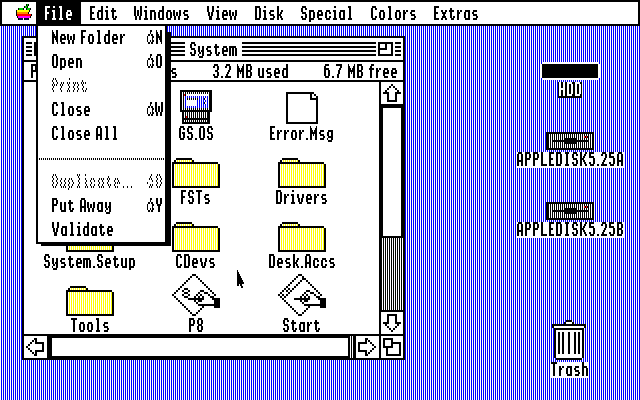
I like to read history books, and that includes the history of the computer industry. Steven Levy's stuff is pretty good, even if sometimes he gets a little breathless in the telling. Dealers of Lightning, West of Eden, Soul of a New Machine, stuff like that.
From reading enough of these, and from the tech press as well, I know there's this notion floating around that during the early 80s Apple was fighting the wrong enemy. (Pirates of Silicon Valley also plays this note.) During that era, Apple focused on IBM instead of on Microsoft. But Microsoft and MS-DOS really won their independence from IBM during the Clone Wars. Everyone wanted to clone the IBM PC, and run MS-DOS on it, because IBM had been so successful. If Apple had somehow won market dominance over IBM in the early 80s, they would have also defeated Microsoft by proxy.
That got me thinking though, that Microsoft probably would not have stayed out of the OS market. They were still a successful applications company at the time and, if PC-DOS had failed, they surely would have made another attempt at an OS product. Now it starts to sound like the plot of a alternate history novel, doesn't it? On the back cover: "What if Apple had defeated IBM in 1984? What if Microsoft had partnered with Commodore to sell MS-Windows in 1986?"
Wow I just realized... if someone wrote that book, I would totally read it.
So... Sun. Oracle. And of course Schwartz. Schwartz, Schwartz. Blogging his way through the graveyard, chanting his open source mantra. As if clinging to all the right buzzwords would make up for not having an actual strategy. "I'm a CEO with a blog! How can my company fail??"
There are lots of companies that get by without a strategy, at least for a while. Hell, I used to work for one. But if you're going to get into the business of being a VAR for a product (free software) whose starting cost is zero and whose cost of duplication is zero, you better have a Goddammed plan of how you're going to add enough value to be attractive.
That's why, even as I care less about free software, I do continue to admire Redhat. They started their business with a plan. And when the market changed and the plan faltered, they got to work on a new plan. This happened to them at least twice, until now Redhat is basically a large consulting firm - which is where most free software VARs seem to end up. But hey, as long as they're making money at it, there's nothing wrong with that.
Sun, on the other hand, seemed to get sucked into the open source zeitgeist of the last decade, rather than deliberately enter it. By 2006 when Schwartz became CEO, the vicious round of consolidations and closures among open source companies was ancient history and he should have been able to learn from it. Instead he seemed to think it was still 1996 and he threw more money at open source products without any clear strategy that I could see. That's why Redhat grew from a dorm room operation to a successful corporation, while Sun dwindled from being a key player to being an easy acquisition.
A Thread Across the Ocean was (to my surprise) the only book I could find that tells the story of laying the first transatlantic communications cable. Luckily, it's a good book. It's a classic story of 19th-century ambition to conquer nature (and get rich doing it) and this book tells it well. Recommendation: acquire.
See also: Cryptonomicon.
I'll give you a little hint here: some of us, back when I was inside the fruity compound, occasionally held contests to see who could get the weirdest, most funky and outrageous, rumors posted to one of the major rumor sites.
- Chuqui 3.0
One of my friends sent me this excellent article examining the state of the mobile app industry. People who want to bitch about the iPhone app model should read some history first. Then at least they can do some informed bitching.
Mobile Applications, RIP
(Originally written April 9, 2004)
Conceptual integrity in turn dictates that the design must proceed from one mind, or from a very small number of agreeing resonant minds.- Frederick Brooks,
The Mythical Man-Month
Date: Thu, 8 Apr 2004 13:47:53 -0500 (EST)
From: Adrian Hosey
To: Thomas R. Hall
Subject: Re: good article
On Thu, 8 Apr 2004, Thomas R. Hall wrote:
: On Thu, 8 Apr 2004, Adrian Hosey wrote:
: >
: > http://mozillazine.org/articles/article4584.html
:
: That is a good article. How do you feel about the role that Mono may play
: in all of this?
I despair of any of it coming together at all. cf. our conversation yesterday about GNOME's failure to produce a scriptable desktop.[1] Granted that hasn't even been a stated goal of GNOME for years, but I hold it up as an example of the amount of energy lost from lack of unified vision and the amount of time spent dorking around with the core components and less time making stuff people can _use._ See also here
http://cinepaint.bigasterisk.com/WhyMigrateFromGTKToFLTK
I think the desktop battle has been lost for at least one more generation. i.e. FOSS guys aren't going to get their shit together in time to defray the market dominance of Longhorn. However I also don't believe that Longhorn will somehow signal the end of the contest the way Brendan Eich thinks it will. The current set of tensions will continue on into another round.
If someone is going to unhorse Microsoft on the desktop I don't think it will be FOSS as we know it. It may be Apple (wishful thinking) it may be Novell/Ximian - in which case Mono would play a big part in the new architecture. It may be someone we haven't met yet. I don't think there's room to bring a whole new closed-source OS to the marketplace right now (witness BeOS) but there's no reason someone can't deliver a quality desktop OS on a Linux kernel, if the project is executed with some focus. Ironically this may put Novell in the best position. They should break with GNOME and just do their own thing the way they think it should be done. Do it open source, do it closed source, but do it with hierarchical leadership and not design by committee.
If you're thinking that Mono will bring home the promise of write once run anywhere between Linux and Microsoft platforms, I don't think that's going to fly. Microsoft will make sure it doesn't. Look at SMB. Look at W2k's broken Kerberos. Look at the history of Java. Look at per-processor licensing. It is not the nature of that corporation under its current leadership to play on an open field.
[1] This is alluding to an earlier conversation of which I don't have a transcript. But recently I've been learning about Apple Events, Applescript, and the ability of other scripting languages to substitute for Applescript via OSA. When I started using GNOME in 1998 I was drawn to it by a post from Miguel de Icaza that described GNOME's goal to be a scriptable, network-transparent desktop environment. I can't find a record of that post but there is this article. Skip down to the question "What differentiates Gnome from other window managers?" to read Miguel describing the vision he had for GNOME back in 1998.
I was really excited by his vision. He was describing a Linux desktop that would not just equal other desktop systems but leapfrog them in features and power. The closest thing on a Unix desktop might have been NeWS - and NeWS is long gone. It was going to have embeddable components and network transparency via CORBA. It was going to support bindings for multiple scripting languages which would drive the components via their CORBA interfaces. It was going to kick ass.

If you get on Google you can find posts I made to the GNOME mailing lists. You can find a few small patches I submitted, those patches now gone because their code bases have long since been rewritten. I was excited and I wanted to be involved in whatever small way I could. That was six years ago.
I'm bummed that in six years GNOME has not yet become a scriptable network-transparent desktop. What bums me the most is that it never will be. GNOME no longer even aspires to those things. Read contemporary editorials about the future of GNOME and you'll hear about things like HAL and DBUS and transparent windows via OpenGL. Nothing that other desktops aren't already doing. At the best one could say that GNOME aspires to be a best-of-breed hybrid from among the current desktop systems. At the worst one could accuse it of being a knock-off.
What happened? I'm not sure. My first thought was that GNOME needed a benevolent dictator and it never really had one. On the other hand there are many open source projects that run based on a "foundation" that do okay, like Apache. Is there some set of criteria that determines what kind of projects need a benevolent dictator?
Some of the language in that email is probably harsher than is fair, but I wanted to repost it verbatim because it conveys a certain amount of frustration. I'm sure most of the contributing programmers to GNOME have their shit together as people, because finding the time to do free software is hard. However if we speak of the GNOME project as if it were a person, I don't think the GNOME project has its shit together, citing the many fickle changes in direction over the years regarding various components. That's why I think the project could have benefited more from the benevolent dictator model. Or maybe the GNOME project does have its shit together and it just didn't put its shit in the basket where I wanted it to. I do feel confident that the GNOME that exists today is not the GNOME put forward in 1998.
Anyway that's why I suggested above that Novell "should break with GNOME and just do their own thing the way they think it should be done." I don't know if Miguel still has his sights set on the vision he described in 1998. If he does he should just do it and not worry anymore about playing nice with the other programmers.
Update 2006-02-08: I'm not saying anyone heard me in particular, but just check it out.
I know we're not supposed to laugh at our own jokes, but once in a while I find something I forgot I had written, and if it makes me laugh to see it again, I feel like I must have done something right.
Project Dresden
When I was in 2nd grade we got our first computer at home, an Apple ][+. One of the first softwares my dad bought to go with it was a game called "The Prisoner", loosely based on the Patrick McGoohan TV show of the same name. This was a very early game, a strange mish-mash of hi-res, lo-res, and text graphics.
One of the more distinctive traits of the game was that whenever someone "talked" to you - talking consisted of capital letters crawling across a window of lo-res block graphics - each letter was accompanied by ringing the computer's "bell" at varying pitches. I think they were going for some effect like the school teacher in Peanuts but the Apple's bell was better at making higher pitched sounds so that's what they used. The effect was like - well, like nothing else I can think of. If you ever had an Apple ][ you probably know what I mean.
Anyway, just like in the TV show, everyone on the Island ended their conversations with a cheery "Be seeing you!" (It was irony, see, because they were all prisoners on the Island - you're not going anywhere far.) Every conversation ended with "Be seeing you" and the pattern of the bells was always the same.
Every once in a while when I'm talking to someone in IM one of us will say "Be seeing you" and oddly enough the pacing of your average touch typist exactly matches the printing speed of that old Prisoner game. As soon as I start to see those letters I always always hear the bells in my head. I'm sure I'll hear them until the day I die.
Weird.
From the Q&A section of this week's Apple press conference:
"Introduced multitouch on iPhone, what about for the Mac?"
Steve: "Makes sense for the iPhone, not sure it makes sense in the Mac. Classify that as a research project."
(taken from Engadget)
Some people really latch on to this idea. Other people dismiss it, citing the well-known gorilla shoulders effect. I think they're both right, because they're not necessarily talking about the same thing.
But first, if you're not familiar with gorilla shoulders, you need to be. Try this:
1) Extend your arm straight in front of you, parallel to the floor.
2) Extend your index finger.
3) Keeping your arm straight, rotate your index finger in a circle approximately four inches in diameter.
4) Every third rotation, make a jabbing motion with your arm.
Keep doing that, and make a note of how long it takes you to reach "uncomfortable" and then "tired." It's faster than you think. Lots of people use their arms all day - it's called "manual labor." But the particular angles of using a touch screen display on a desktop present unique physical demands. Touchscreen displays have already been tried in the mid-1980s, usually on the workstations of places like banks, and the fatigue effects became known as "gorilla shoulders."
Now with a laptop, it's a different story. The distance is much shorter and the angle is different. I could see a multitouch display on a laptop, in addition to a keyboard and trackpad. So instead of reaching for the trackpad, I just reach out and touch the thing that I want. Try it on your laptop right now. Personally I'd find that superior for most cases of scrolling, and manipulating icons, but I'd go to the trackpad for fine details, like bandboxing an image region for cropping.
That's why I say both camps are right. People who get excited about a multitouch "Mac" really want a multitouch Macbook, and people who already know the history of gorilla shoulders automatically hear multitouch iMac and reflexively say no, that doesn't work.
Why is it a historic new keyboard? Check out this photo from Engadget. For the first time in a long time, we have a Mac keyboard where the Command key is not also the "Apple" key.
I've had a strange fascination with the history of the "Command/Apple" key ever since I learned that the original Macintosh used the ⌘ symbol exclusively in the interface, and did not have the Apple symbol on its keyboard:

(Photo from aresluna reprint of Byte Magazine)
But by the time I was doing computer lab support in the mid-90s, Apple keyboards had both symbols on the same key, and everyone in the Mac labs spoke of "Command-S" and "Apple-S" interchangeably. When did those two get conflated, if the original Mac never used the Apple symbol?
It goes back to the Apple IIgs, and the Apple Desktop Bus. ADB was sort of an early version of USB, a unified cabling and signaling interface for peripheral devices that was capable of daisy-chaining. ADB was introduced on the IIgs in 1986 and on the Macintosh II in 1987. This allowed Apple to supply a single keyboard model for both the IIgs and the Macintosh line. The Macintosh of course had the Command key as its primary meta key, but the IIgs was descended from the //e and so used the Apple key as its meta key:

(Photo from the Graphical User Interface Gallery)
So the two keys became one on the unified ADB keyboard, to wit:

(Photo from the Flickr stream of jd_wages)
The IIgs finally reached its end of life in 1992, so why did the Apple symbol continue to live on the Macintosh keyboard for another 15 years? Why choose now to get rid of it?
This August marks the tenth anniversary of Macworld Boston 1997, AKA "The Return of Steve Jobs." You can see the video of his speech here:
http://www.youtube.com/watch?v=PEHNrqPkefI
At the 23 minute mark, he says something very interesting. He says that when he returned to Apple and examined the state of the company, he uncovered two core assets: the Apple brand name, and the MacOS software. Looking back over the last ten years, it is striking how well Apple has executed on leveraging those assets. They have leveraged the Apple brand into markets previously considered tangential to personal computing, and they have continued to invest heavily into creating and maintaining the best personal computer operating system available.
Also notice at the 27 minute mark, when he announces the infamous Microsoft "partnership", how he is carefully conciliatory and diplomatic towards Microsoft. Certainly, that didn't last. Probably, with Apple on the brink of ruin, Jobs wanted the option of increased cooperation on the table, but it turns out they didn't need it. Now, they obviously feel very confident and comfortable in making fun of Microsoft.
One of the local TV stations just finished running a Top 50 countdown of the best Simpsons episodes ever. They had Homer's Religion at #2 and the Dental Plan at #1. Those are great episodes, but I wouldn't have put them at 1 and 2. They made some other very questionable choices, like putting the Spring Break episode way back in the 40s.
My top episodes would look like this:
8. The Swimming Pool ("See, your epidermis means your hair, so technically, it's true.")
7. The Lemon Tree ("Run faster boy! He's got a taste for meat now!")
6. Homer Goes on Disability ("Stupid bird! I never should have left you in charge!")
5. Dental Plan ("See here Mr. Burns, I don't go in for these backdoor shenanigans.")
4. Lisa's Beach Vacation ("SWEET MERCIFUL CRAP! My CAR!")
3. Homer's Religion ("If I'm wrong, I'll recant on my deathbed.")
2. Bart's Soul ("Milhouse give him his soul back! I've got work tomorrow!")
1. Bart's Spring Break ("No, Principal Skinner, Bart's never been to Thailand.")
#1 and #2 is a really close call, because the Spring Break episode probably has more laughs, but Bart's Soul is the only Simpsons episode that is also beautiful.
By now everyone who knows about the iPhone also knows that Cisco owns the trademark on "iPhone" in the United States. Cisco and Apple were in negotiations over the US trademark, but then Cisco got mad and decided to take it to court. Everyone assumes it's a matter of money. But now Cisco has said something very interesting:
What were the issues at the table that kept us from an agreement? Was it money? No. Was it a royalty on every Apple phone? No. Was it an exchange for Cisco products or services? No.
Fundamentally we wanted an open approach. We hoped our products could interoperate in the future.
- http://blogs.cisco.com/news/2007/01/update_on_ciscos_iphone_tradem.html
Reading between the lines, Apple already tried greeting Cisco with a dumptruck full of cash, and Cisco said "no, thanks, we already have several of those." Rather, Cisco wanted to be allowed to play in Apple's new ballpark. Rather a cagey move by Cisco. But Apple, famous for exerting end-to-end control over their products, naturally balked at that.
But then why did Apple go ahead and announce it as "iPhone" anyway?
For starters, Apple does own a trademark on "iPhone" in some other countries, just not in the United States. If you announce a product which will (eventually) be sold in those countries, but you make the announcement in a country where you don't hold the trademark, have you broken the law? I don't know.
Also, remember that about 6 months ago, Apple pre-announced a product codenamed "iTV" which is now officially known as tv (or, AppleTV.) Are they going to defend against the lawsuit by saying iPhone is just a project name? Is that a defensible position? Again, don't know.
Several people, including the venerable Bob Cringely, are going with the theory that any publicity is good publicity, and announcing it as the "iPhone" now cements the correlation between iPod and iPhone in the public consciousness, even if it ships under another name.
Or, did Apple just assume everything would work out the way they wanted? That would be a very John Sculley thing to do, but it's not beyond possibility.