Peeve of the moment: Whenever some people refer to the Mac's standard Mail program as "Mail.app" or "Mail-dot-app". I also sometimes hear "Terminal-dot-app", and I expect I'm going to hear "Numbers-dot-app". Yes, "Mail" is a very vanilla name for a program. Yes it needs to be disambiguated from other mail programs, and even from the common noun "mail." But you never hear people say "Word-dot-exe". They call it "Microsoft Word" to disambiguate it from other "words". Likewise, let's call it "Apple Mail". After all, that's what it calls itself:
X-Mailer: Apple Mail (2.752.3)
Google gets it.
From the Q&A section of this week's Apple press conference:
"Introduced multitouch on iPhone, what about for the Mac?"
Steve: "Makes sense for the iPhone, not sure it makes sense in the Mac. Classify that as a research project."
(taken from Engadget)
Some people really latch on to this idea. Other people dismiss it, citing the well-known gorilla shoulders effect. I think they're both right, because they're not necessarily talking about the same thing.
But first, if you're not familiar with gorilla shoulders, you need to be. Try this:
1) Extend your arm straight in front of you, parallel to the floor.
2) Extend your index finger.
3) Keeping your arm straight, rotate your index finger in a circle approximately four inches in diameter.
4) Every third rotation, make a jabbing motion with your arm.
Keep doing that, and make a note of how long it takes you to reach "uncomfortable" and then "tired." It's faster than you think. Lots of people use their arms all day - it's called "manual labor." But the particular angles of using a touch screen display on a desktop present unique physical demands. Touchscreen displays have already been tried in the mid-1980s, usually on the workstations of places like banks, and the fatigue effects became known as "gorilla shoulders."
Now with a laptop, it's a different story. The distance is much shorter and the angle is different. I could see a multitouch display on a laptop, in addition to a keyboard and trackpad. So instead of reaching for the trackpad, I just reach out and touch the thing that I want. Try it on your laptop right now. Personally I'd find that superior for most cases of scrolling, and manipulating icons, but I'd go to the trackpad for fine details, like bandboxing an image region for cropping.
That's why I say both camps are right. People who get excited about a multitouch "Mac" really want a multitouch Macbook, and people who already know the history of gorilla shoulders automatically hear multitouch iMac and reflexively say no, that doesn't work.
Why is it a historic new keyboard? Check out this photo from Engadget. For the first time in a long time, we have a Mac keyboard where the Command key is not also the "Apple" key.
I've had a strange fascination with the history of the "Command/Apple" key ever since I learned that the original Macintosh used the ⌘ symbol exclusively in the interface, and did not have the Apple symbol on its keyboard:

(Photo from aresluna reprint of Byte Magazine)
But by the time I was doing computer lab support in the mid-90s, Apple keyboards had both symbols on the same key, and everyone in the Mac labs spoke of "Command-S" and "Apple-S" interchangeably. When did those two get conflated, if the original Mac never used the Apple symbol?
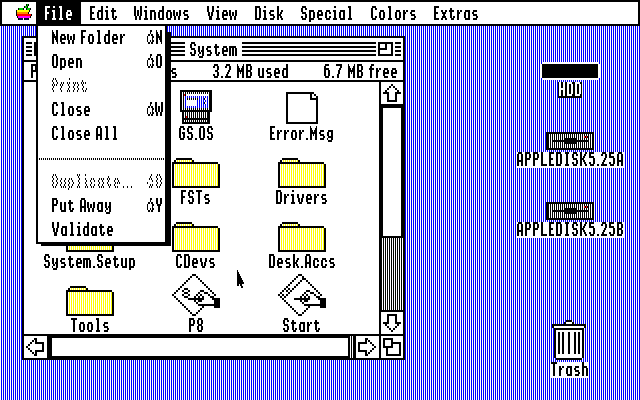
It goes back to the Apple IIgs, and the Apple Desktop Bus. ADB was sort of an early version of USB, a unified cabling and signaling interface for peripheral devices that was capable of daisy-chaining. ADB was introduced on the IIgs in 1986 and on the Macintosh II in 1987. This allowed Apple to supply a single keyboard model for both the IIgs and the Macintosh line. The Macintosh of course had the Command key as its primary meta key, but the IIgs was descended from the //e and so used the Apple key as its meta key:

(Photo from the Graphical User Interface Gallery)
So the two keys became one on the unified ADB keyboard, to wit:

(Photo from the Flickr stream of jd_wages)
The IIgs finally reached its end of life in 1992, so why did the Apple symbol continue to live on the Macintosh keyboard for another 15 years? Why choose now to get rid of it?
This August marks the tenth anniversary of Macworld Boston 1997, AKA "The Return of Steve Jobs." You can see the video of his speech here:
http://www.youtube.com/watch?v=PEHNrqPkefI
At the 23 minute mark, he says something very interesting. He says that when he returned to Apple and examined the state of the company, he uncovered two core assets: the Apple brand name, and the MacOS software. Looking back over the last ten years, it is striking how well Apple has executed on leveraging those assets. They have leveraged the Apple brand into markets previously considered tangential to personal computing, and they have continued to invest heavily into creating and maintaining the best personal computer operating system available.
Also notice at the 27 minute mark, when he announces the infamous Microsoft "partnership", how he is carefully conciliatory and diplomatic towards Microsoft. Certainly, that didn't last. Probably, with Apple on the brink of ruin, Jobs wanted the option of increased cooperation on the table, but it turns out they didn't need it. Now, they obviously feel very confident and comfortable in making fun of Microsoft.