Why is it a historic new keyboard? Check out this photo from Engadget. For the first time in a long time, we have a Mac keyboard where the Command key is not also the "Apple" key.
I've had a strange fascination with the history of the "Command/Apple" key ever since I learned that the original Macintosh used the ⌘ symbol exclusively in the interface, and did not have the Apple symbol on its keyboard:

(Photo from aresluna reprint of Byte Magazine)
But by the time I was doing computer lab support in the mid-90s, Apple keyboards had both symbols on the same key, and everyone in the Mac labs spoke of "Command-S" and "Apple-S" interchangeably. When did those two get conflated, if the original Mac never used the Apple symbol?

It goes back to the Apple IIgs, and the Apple Desktop Bus. ADB was sort of an early version of USB, a unified cabling and signaling interface for peripheral devices that was capable of daisy-chaining. ADB was introduced on the IIgs in 1986 and on the Macintosh II in 1987. This allowed Apple to supply a single keyboard model for both the IIgs and the Macintosh line. The Macintosh of course had the Command key as its primary meta key, but the IIgs was descended from the //e and so used the Apple key as its meta key:
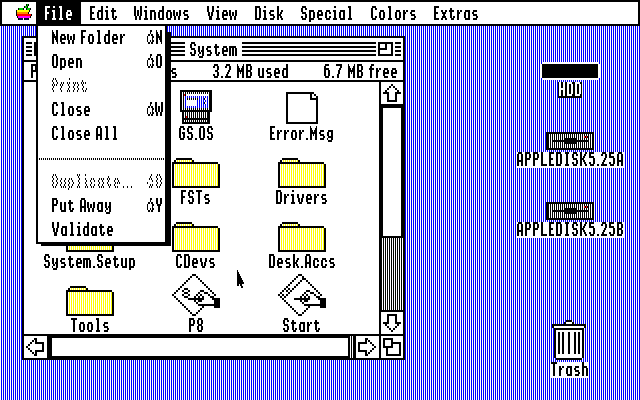
(Photo from the Graphical User Interface Gallery)
So the two keys became one on the unified ADB keyboard, to wit:

(Photo from the Flickr stream of jd_wages)
The IIgs finally reached its end of life in 1992, so why did the Apple symbol continue to live on the Macintosh keyboard for another 15 years? Why choose now to get rid of it?

No comments:
Post a Comment